Greetings from Eurania.
It is suspected that the Great Nebula of Eurania is the remnant of the cataclysmic explosion of the Euranian star of origin. The supernova bisected the star cluster and destroyed the ancient Etolian empire. While no images are known to exist of the Euranian remnant, or the many neutron stars situated within, the famous Crab Nebula, with its pulsar, offers a suggestion of what it might be similar to.
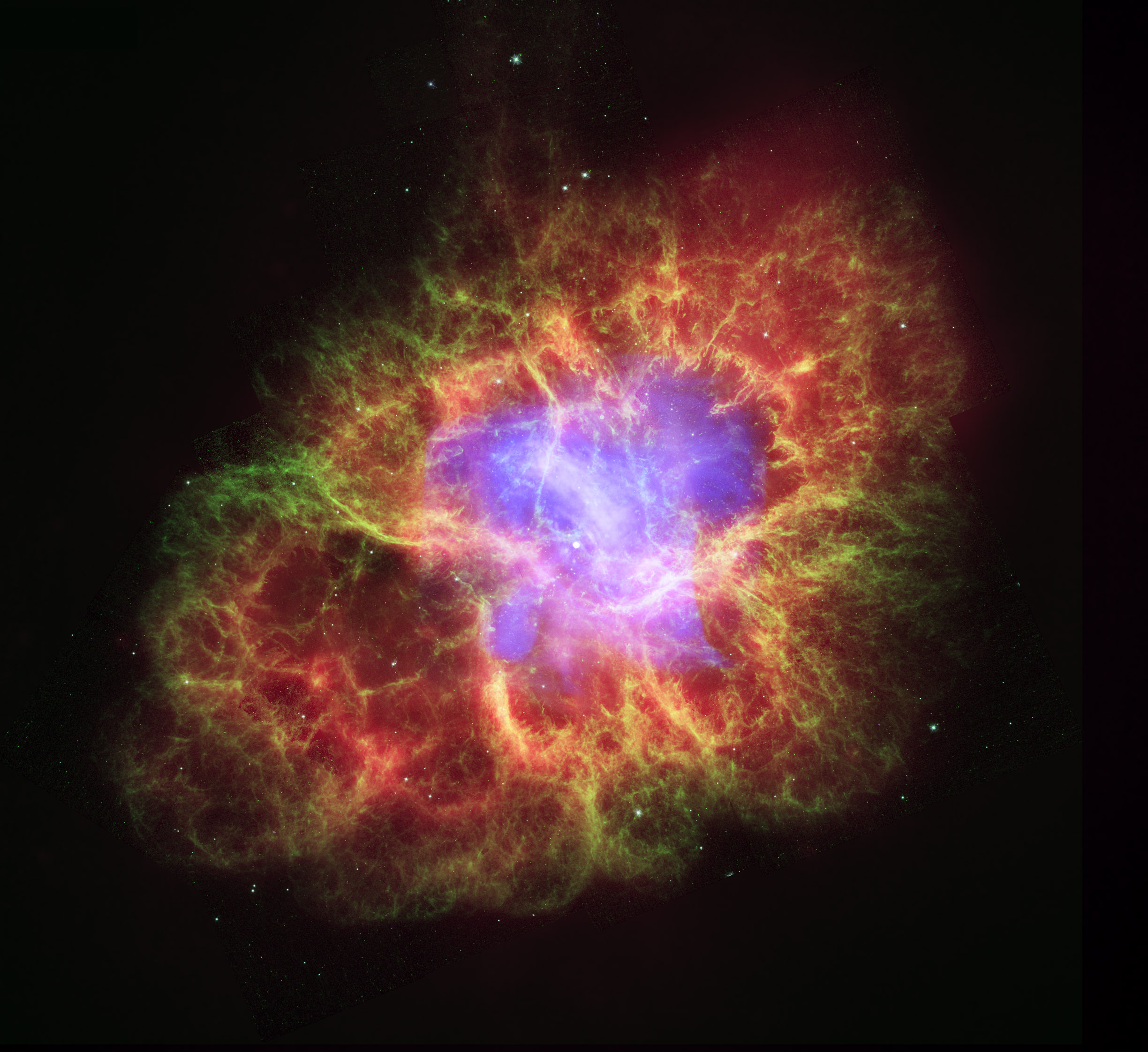
ABOUT THIS IMAGE:
This composite image of the Crab Nebula uses data from three of NASA’s Great Observatories. The Chandra X-ray image is shown in light blue, the Hubble Space Telescope optical images are in green and dark blue, and the Spitzer Space Telescope’s infrared image is in red. The size of the X-ray image is smaller than the others because the outwardly streaming higher-energy electrons emitting X-ray light radiate away their energy more quickly than the lower-energy electrons emitting optical and infrared light. The neutron star, which has the mass equivalent to the sun crammed into a rapidly spinning ball of neutrons twelve miles across, is the bright white dot in the center of the image.
Credit: NASA, ESA, CXC, JPL-Caltech, J. Hester and A. Loll (Arizona State Univ.), R. Gehrz (Univ. Minn.), and STScI.
The inner region of the Crab Nebula around the pulsar was observed with Hubble on 24 occasions between August 2000 and April 2001 at 11-day intervals, and with Chandra on eight occasions between November 2000 and April 2001. The Crab was observed with Chandra’s Advanced CCD Imaging Spectrometer and Hubble’s Wide-Field Planetary Camera.
Credit: NASA/HST/ASU/J.Hester et al.